An isolated English country estate in 1924. Outside, a violent summer storm is lashing the windows, the streets are flooded and the iron gates are locked. Inside, in the opulent Victorian Salon, there is a dead man, and the murderer is still sitting among the guests. "The Shadows of Thornfield Hall" is an interactive crime story that focuses entirely on the dense atmosphere of a classic whodunit concentrated. Instead of predetermined answers or rigid dialogue trees, you move freely through the house and shape the investigation in your own words.
The focus is on razor-sharp observation. You take the time to really perceive the crime scene - from the still smoldering pipe tobacco to the relentless ticking of a grandfather clock to a forgotten, cold cup of tea. Every seemingly banal prop can be narratively dissected down to the smallest detail and perhaps hides the crucial clue. While you are your own actions, steps and thoughts If you live in the first person perspective, the narrator captures the guests' reactions and the oppressive mood of the house for you like a cynical, attentive author from the 1920s.
The suspects at Thornfield Hall aren't making it easy for you. The perpetrator defends himself, actively constructs alibis, deflects suspicion and, at most, reveals himself through tiny micro-expressions of panic. Those too Innocent guests often behave evasively, simply to protect their own little everyday secrets. Every statement you hold and every evidence you find remains immovable in the world - Objects remain exactly where you discover them unless you consciously take them. You can only force a confession when you put together the contradictions you have collected and bring someone with you irrefutable facts lead you into a hopeless logical trap. Until then, all you have left is the house, the raging storm, and the constant feeling that someone in the room is lying.
Who is the perpetrator this time? The butler, the maid, the baroness?
And where? In the salon?
And with what?
Lots of but finite possibilities.
But with AI, with new alibis, motives, secrets and relationships woven into the narrative, this becomes almost endless possibilities.
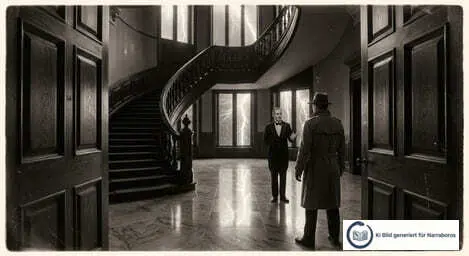
Szene aus the Shadows of Thornfield Hall: erzeugt mit einem Bilderprompt, den dir Narraboros zur Verfügung stellt und den du mit jedem kompatiblen Bildmodell nutzen kannst.
Eye-level view from the front doors facing inward, grand sweeping staircase in an English manor, cold marble floors reflecting violent lightning strikes from outside, imposing wooden entrance doors, tense and dramatic An authentic 1920s vintage photograph, archival silver gelatin print, black and white with a subtle warm sepia tint. High contrast with deep, heavy shadows and soft highlights. Authentic vintage film grain, minor dust, scratches, and chemical imperfections. Slight lens vignette and soft focus around the edges. Captured as if by a 1920s camera. Wide architectural establishing shot, clear spatial layout. [Detective] Standing. 0 meters from [Marmor-Foyer]. Facing [Interior]. [Butler_Markus_Mraz] Standing. 2 meters from [Detective]. Facing [Detective].
Ein Ausschnitt aus dem Co-Authoring Spieler + KI:
Spieler:
Der Detektiv kam am Anwesen an.KI-Erzähler:
Der Regen peitschte unbarmherzig gegen die bleiverglasten Fenster des Marmor-Foyers, ein rhythmisches Trommeln, das die Stille im Inneren nur noch schwerer machte. Die Luft roch nach nassem Stein und dem beißenden Aroma von Kaminholz.
Das Foyer wirkte in der Dämmerung wie ein gefrorenes Tableau. Ein Massiver Kronleuchter aus Kristall hing regungslos über dem Eingang, sein Licht spiegelte sich in den Polierten Marmorböden, die jeden meiner Schritte unnatürlich laut widerhallten. Direkt gegenüber der Eingangstür stand eine Antike Standuhr, deren Pendel in einem trägen, fast quälenden Takt schwang.
Der Butler, Markus Mraz, wartete bereits. Sein Gesicht war eine Maske aus professioneller Distanz, doch seine Finger zuckten unwillkürlich an den Knöpfen seiner Livree. Er neigte den Kopf, während der Donner das Haus erschütterte. „Willkommen in Thornfield Hall, Sir. Das Wetter... es ist bedauerlich, dass Sie unter solchen Umständen eintreffen.“ Seine Augen mieden den direkten Blick und fixierten stattdessen einen Punkt knapp über meiner linken Schulter.